Soil Improvement Techniques in Construction: A Full Engineering Overview
Soil conditions do not always cooperate with construction plans. In an ideal world, every project site would have uniform, well-graded, competent soil from the surface down to the required bearing depth. In practice, engineers routinely encounter loose granular fills, soft clays, compressible organics, liquefiable sands, and heterogeneously placed fills with variable density and unpredictable performance.
Soil improvement techniques exist to close that gap. Rather than designing around poor ground conditions with expensive deep foundations or time-consuming over-excavation, a well-specified ground treatment program can bring the existing soil up to the performance level the project requires.
The range of techniques available today is broad. Each works through a different mechanism, targets different soil types, and carries different cost and schedule implications. Choosing the right approach requires a clear understanding of what each technique actually does, where it works best, and what post-treatment verification looks like.
This is a complete engineering reference covering all of the major soil improvement techniques used in construction today, organized to help engineers, consultants, and project owners make informed decisions before they commit to an approach.
Why Soil Improvement Techniques Matter in Modern Construction
Common Soil Problems That Trigger Ground Improvement
The most common triggers for soil improvement in construction include loose granular fills with inadequate bearing capacity, soft cohesive soils prone to excessive long-term settlement, liquefiable sands in seismic zones, and heterogeneous placed fills with variable compaction history.
Each of these conditions creates a different risk profile. Loose fills under a warehouse slab can cause differential settlement that disrupts floor flatness and racking systems. Soft clays under an embankment can result in slope instability or excessive long-term consolidation. Liquefiable sands in a seismic zone can cause catastrophic loss of bearing capacity during a ground motion event.
Identifying the specific mechanism of concern is the first step in selecting an appropriate soil improvement method.
What Soil Improvement Is Designed to Accomplish
Soil improvement programs are designed to achieve one or more of the following outcomes: increased shear strength and bearing capacity, reduced compressibility and settlement potential, accelerated consolidation, improved drainage characteristics, or reduced liquefaction susceptibility.
The target performance is specified in engineering terms, typically as a minimum cone resistance, a bearing capacity value, a maximum settlement under defined loading, or a standard penetration count. That specification drives both method selection and the post-treatment testing program.
The Major Soil Improvement Techniques Used in Construction
The techniques described below represent the main categories in common use across North American construction. Most fall into one of three broad families: densification, reinforcement, or drainage-based consolidation.
Dynamic Compaction
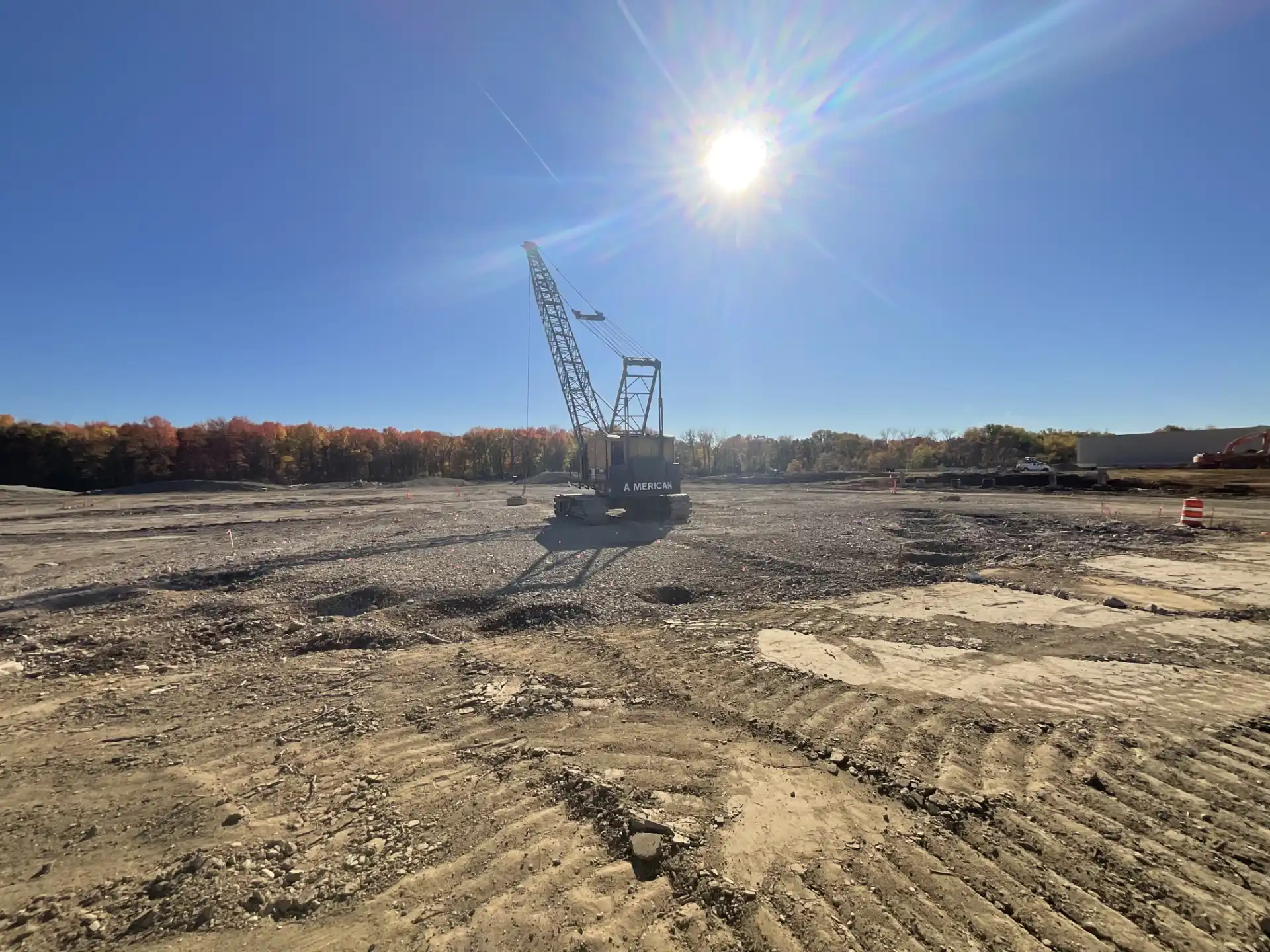
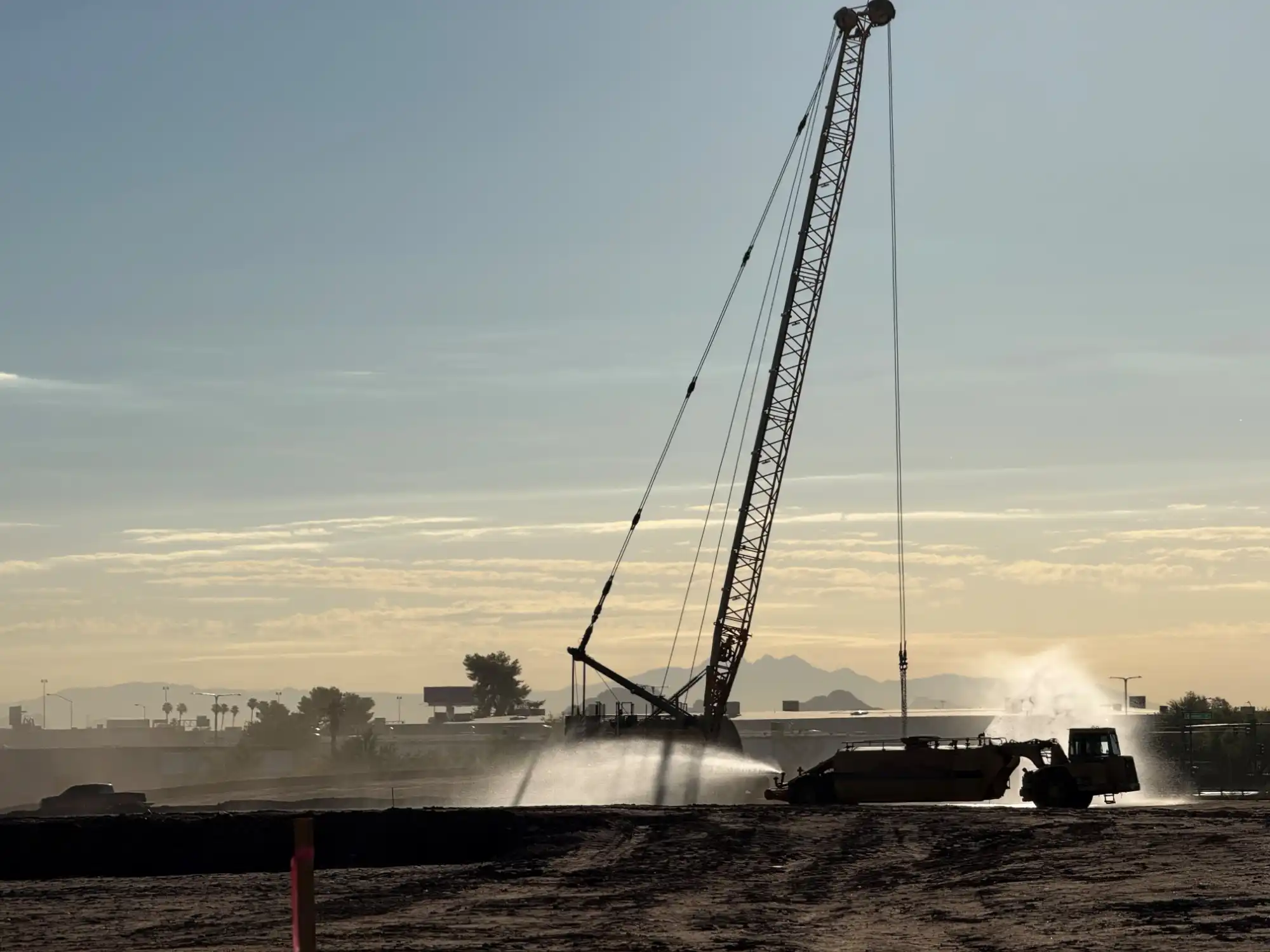
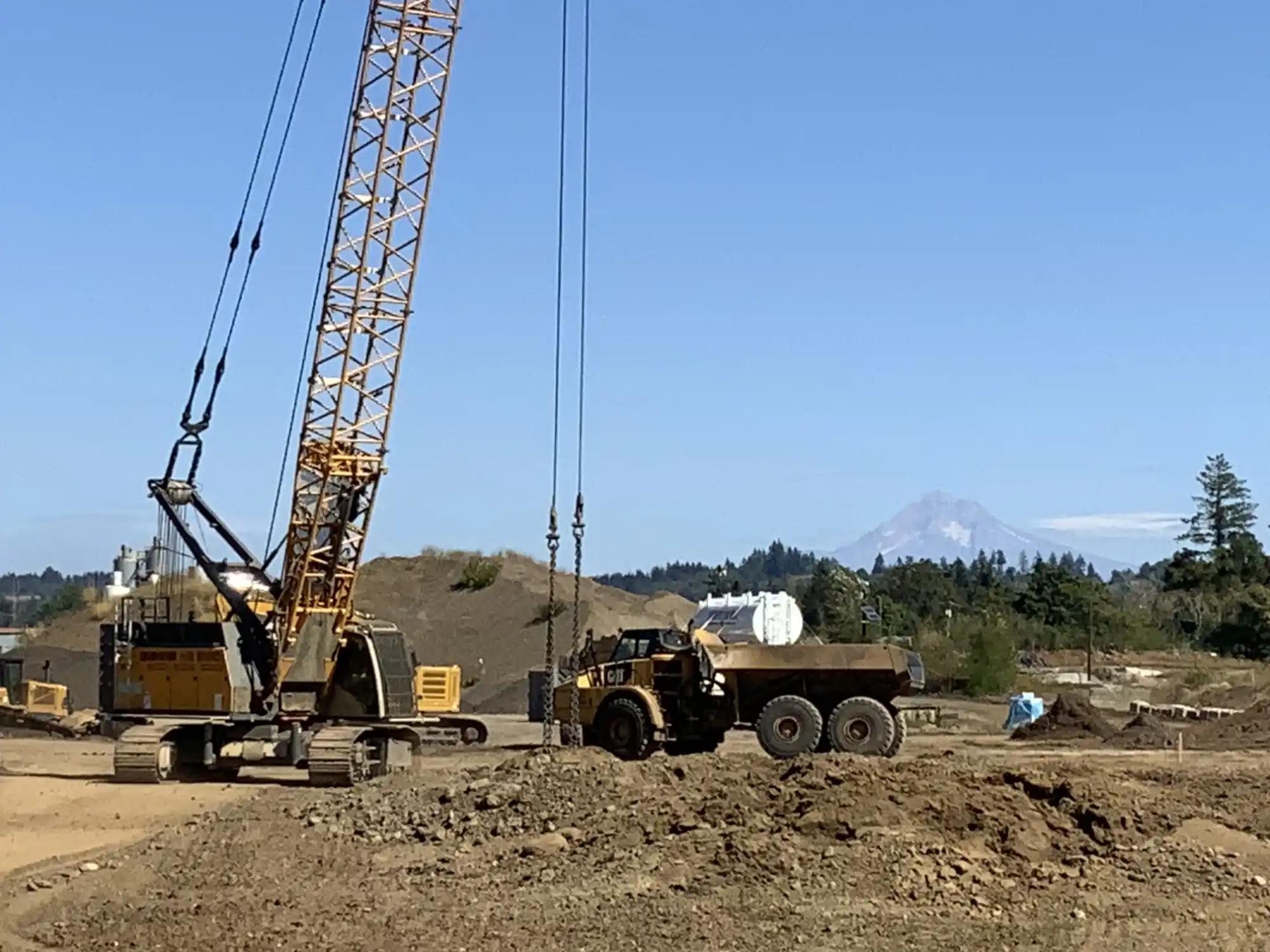
Dynamic compaction is a high-energy densification technique that uses a heavy steel tamper, dropped repeatedly from a crane, to deliver controlled impacts to the ground surface. Each impact sends a wave of energy into the soil below, rearranging loose granular particles into a denser, stronger matrix.
The technique is particularly effective on sands, gravels, silty fills, and non-plastic heterogeneous fills. It treats large areas efficiently, reaches significant depths without excavation or injection, and requires no imported materials beyond the tamper. For many projects on granular soils, it is the most cost-effective soil improvement option available.
We have been executing dynamic compaction scopes across North America since 1993, across a wide range of soil types, treatment depths, and project scales.
Vibro-Replacement (Stone Columns)
Vibro-replacement constructs vertical columns of compacted stone aggregate through weak soil layers by vibrating a probe to create a cavity and then backfilling with crushed stone in lifts. The resulting column provides both load-bearing capacity and drainage, and the vibration process also densifies the surrounding granular material during installation.
Stone columns are best suited to soft to medium cohesive soils and loose granular deposits. They are widely used under embankments, storage tanks, low-rise structures, and approach fills.
Deep Soil Mixing
Deep soil mixing uses rotating auger tools to blend in-situ soil with a cementitious binder, creating treated columns or panels with significantly improved strength and stiffness. The technique can be used to create load-bearing columns similar to rigid inclusions, or to form shear walls and containment barriers.
It is applicable to a wide range of soil types, works well in soft cohesive soils where densification is not feasible, and can be adapted to tight site access conditions with appropriate equipment configurations.
Surcharge and Wick Drains
Prefabricated vertical drains, installed at close spacing through soft cohesive soil, provide drainage pathways that dramatically accelerate consolidation under applied surcharge load. The surcharge, a temporary fill mass, provides the load that drives the consolidation process.
This technique is passive and time-dependent, but it can be highly economical on large sites where the project schedule includes a treatment period. Settlement monitoring and piezometry track progress and confirm when the required consolidation has been achieved.
Grouting and Chemical Stabilization
Grouting encompasses compaction grouting, which displaces and densifies loose soil by injecting expanding grout under pressure, and permeation grouting, which fills voids in coarse granular material. Jet grouting uses high-pressure fluid to disaggregate soil and mix it with grout in place, creating treated columns or panels.
Chemical stabilization, including lime and cement treatment, improves the engineering properties of fine-grained soils through pozzolanic and cementitious reactions rather than mechanical action. It is commonly used for subgrade preparation, road base improvement, and embankment construction on expansive or soft soils.
Soil Improvement Techniques for Industrial Construction: Special Considerations
Industrial projects, including warehouses, logistics centers, heavy manufacturing facilities, and tank farms, often present some of the most demanding ground improvement challenges. Load intensities are high, settlement tolerances are tight, and construction schedules are aggressive.
Load Requirements and Site Constraints in Industrial Settings
Industrial floor slabs, heavy racking systems, and large-diameter storage tanks all impose concentrated loads that amplify the consequences of inadequate bearing capacity or differential settlement. A floor flatness specification of F-number 50 in a modern distribution center, for example, leaves almost no margin for post-construction movement.
Site access conditions in industrial construction also tend to favor methods that can treat large areas efficiently. Soil stabilization techniques in industrial construction frequently need to address fills placed over decades without consistent compaction control, often to depths that surface compaction cannot reach.
Why Dynamic Compaction Excels on Industrial Sites
For industrial sites on granular soils, dynamic compaction routinely delivers the combination of treatment depth, areal coverage, and post-treatment density that these projects require. The method’s ability to treat heterogeneous filled ground, including demolition rubble and mixed industrial fills, makes it particularly well-suited to brownfield redevelopment sites where other methods would struggle with variable conditions.
The absence of any imported material requirement, combined with relatively rapid treatment rates over large areas, gives dynamic compaction a strong cost and schedule advantage on the types of large flat sites that industrial development typically involves.
How to Choose the Right Soil Improvement Technique
Method selection is a multi-variable decision. No single technique works for every soil condition, and the right choice for one project can be entirely wrong for another.
Key Variables: Soil Type, Load, Timeline, Access
Soil type is the primary filter. Granular soils respond to densification. Cohesive soils require reinforcement, drainage, or replacement. Mixed profiles often require hybrid approaches.
Load intensity and distribution determine the required bearing capacity and settlement performance, which sets the performance target the treatment must achieve. Timeline drives the feasibility of consolidation-based approaches. Site access constraints, including overhead clearance, equipment dimensions, and proximity to existing structures, can eliminate certain methods entirely regardless of their technical suitability.
The Role of Post-Improvement Testing in Verifying Results
Method selection should never be made without also specifying the post-treatment testing program. The two are linked: the performance target defines what needs to be demonstrated, and the testing program defines how it will be measured.
Common testing methods include CPT, SPT, pressuremeter tests, plate load tests, and full-scale load tests depending on the method and the performance specification. The Federal Highway Administration’s Ground Improvement Reference Manual provides detailed guidance on testing protocols and acceptance criteria for all major technique categories.
Foundation Soil Improvement: Technique Selection by Structure Type
The appropriate technique for foundation soil improvement varies significantly depending on the type of structure being supported and its sensitivity to settlement.
Residential and Light Commercial Applications
For residential construction on variable fills or loose native soils, dynamic compaction and vibro-compaction offer cost-effective solutions that significantly reduce settlement risk and improve bearing capacity. Foundation soil improvement in these applications typically targets the upper several metres of fill, where treatment has the most direct impact on slab and shallow foundation performance.
Heavy Industrial, Infrastructure, and Port Applications
For heavy industrial structures, infrastructure embankments, and port facilities, treatment depth requirements are typically greater, load intensities are higher, and the consequences of under-performance are more severe. Rigid inclusions, deep dynamic compaction, and stone column programs are commonly specified in these applications, often in combination with a comprehensive load testing program.
The ASCE Geo-Institute publishes technical guidance on foundation design in improved ground and supports ongoing research into performance-based ground improvement specifications.
What Does a Full Soil Improvement Scope Include?
A complete soil improvement scope is more than just the execution of a treatment method. It includes design input, equipment mobilization, execution, monitoring, and verification, all of which contribute to the final result.
Assessment and Design
A proper soil improvement scope begins with a geotechnical investigation that characterizes the problematic soil layers, defines the treatment depth, and establishes the performance specification. Method selection follows from that data, along with energy or installation parameters that are calibrated to the specific soil conditions.
Execution and Equipment
The quality of execution is largely a function of the equipment being used and the experience of the crew operating it. Purpose-built equipment, operated by crews with deep experience in the specific technique, produces more consistent and reliable results than generic or rented equipment operated by generalist crews.
Our full-scope ground improvement capabilities include purpose-built equipment fleets, experienced field crews, and the technical depth to manage complex projects from initial mobilization through final verification.
Verification and Documentation
The scope is not complete until the post-improvement testing program confirms that the performance targets have been met and the results have been documented in a format that serves the project record. This includes all pre-treatment and post-treatment test data, installation records, and a comparison of achieved results against the specification.
Working with a Soil Improvement Contractor: What Engineers Should Expect
Selecting the right contractor for soil improvement work requires more than just a price comparison. The depth of experience, equipment capability, and in-house technical resources a contractor brings to a project have a direct impact on the quality and reliability of the result.
Turnkey vs. Scope-Limited Engagements
A contractor who can deliver a turnkey soil improvement scope, managing everything from design input and mobilization through execution and post-treatment verification, provides clearer accountability and reduces coordination risk for the project team. Scope-limited engagements where execution is separated from design input and testing can create gaps in accountability that become problems when results are disputed.
Questions to Ask Before You Specify a Method
Before committing to a technique, ask the contractor to provide project references on comparable soil conditions, describe the specific equipment that would be used, explain how the post-treatment testing program will be structured, and confirm their in-house capacity for vibration monitoring during execution.
A contractor who can answer all of those questions with specific, documented responses, rather than general assurances, is one who has the experience to deliver consistently.
We have been delivering soil improvement scopes since 1993, across North America and on international projects. If you are in the planning or specification phase of a project, we welcome the conversation. Send our team an email at info@densification.com and let us know what you are working on.
Frequently Asked Questions
What is the difference between soil improvement and soil stabilization?
Soil improvement is a broad term covering techniques that enhance the engineering properties of existing soil, including strength, stiffness, drainage, and density. Soil stabilization is a subset that typically refers to chemical or mechanical treatment to stabilize fine-grained soils for use in pavement subgrades or embankments. The two terms are sometimes used interchangeably, but soil improvement encompasses a wider range of techniques and applications.
Which soil improvement techniques work best on soft clay?
Soft clay soils are generally not amenable to densification methods. The most effective techniques for soft clay include stone columns (vibro-replacement), rigid inclusions, deep soil mixing, and consolidation approaches using wick drains and surcharge. The right choice depends on the clay’s shear strength, plasticity, drainage characteristics, and the load and settlement requirements of the project.
How do you verify that soil improvement techniques have worked?
Verification depends on the method and the performance target. For densification methods, CPT and SPT are the primary tools. For consolidation methods, settlement monitoring and piezometry track progress. For load-bearing methods, plate load tests and full-scale load tests confirm performance. A defined testing program tied to specific acceptance criteria should be established before any ground improvement work begins.
Can soil improvement techniques eliminate the need for deep foundations?
In many cases, yes. When the problematic soil layer is not extremely deep and the structural load profile does not require precision load transfer to a specific bearing stratum, ground improvement can bring the existing soil up to a level where shallow foundations or ground-supported slabs are fully adequate. The economics typically favor ground improvement over deep foundations in these situations, often significantly.
What is the typical cost range for soil improvement?
Cost varies significantly by method, treatment depth, site conditions, and project scale. Dynamic compaction is generally among the most cost-effective options for granular soils on open sites. Rigid inclusions and deep soil mixing carry higher material and installation costs but provide precise load transfer. The most accurate way to evaluate cost is through a project-specific scope and quote from a contractor with direct experience on similar conditions.