Ground Vibration Monitoring Explained for Engineers and Contractors
Ground vibration monitoring is an essential technical infrastructure for modern ground improvement projects. Whether you’re managing dynamic compaction, soil densification, rigid inclusions, or other ground modification techniques, real-time vibration data transforms operational decisions from guesswork into engineering-based optimization.
This comprehensive guide explains how ground vibration monitoring works, what systems measure, when to deploy monitoring, and how to select the right solution for your project.
What Is Ground Vibration Monitoring?
Ground vibration monitoring is the continuous measurement, recording, and analysis of ground movement caused by construction operations, natural phenomena, or equipment operation. In the context of ground improvement, monitoring quantifies how soil responds to compaction forces and ensures that operations achieve design goals while protecting adjacent areas.
Definition and Core Principles
Ground vibration monitoring captures three fundamental principles. First, vibration is a measurable motion that can be quantified in specific units and directions. Second, vibration effects depend on amplitude, frequency, and duration combined. Third, ground response to vibration is predictable and can be modeled to forecast project outcomes.
Monitoring systems work by converting ground motion into electrical signals, digitizing those signals, and analyzing them with specialized software. The result is objective data that replaces subjective judgment about ground conditions and compaction effectiveness.
Why Ground Vibration Monitoring is Critical
Ground improvement projects operate in uncertainty. Subsurface conditions vary. Compaction effectiveness depends on soil type, moisture, and equipment interaction. Adjacent structures, utilities, and environmental features impose constraints. Vibration monitoring reduces this uncertainty by providing direct observation of soil response.
Real-time monitoring data answers critical questions: Is compaction achieving design density? Are vibrations affecting nearby structures? Are operations within regulatory compliance limits? How does soil response vary across the project site? Answers to these questions guide decisions that affect project success, cost, and schedule.
Applications in Ground Improvement
Ground vibration monitoring applies across the full spectrum of ground improvement techniques. Dynamic compaction uses vibration data to verify that shock waves penetrate to design depths and achieve compaction throughout target zones. Soil densification projects monitor settlement response in real-time. Stone column installations track installation vibration and settlement patterns. Rigid inclusions projects monitor ground response around installed elements.
Testing and verification after ground improvement rely on vibration monitoring baseline data. Post-improvement testing confirms that design objectives were achieved and documents project compliance.
Types of Ground Vibration Monitoring Systems
Ground vibration monitoring systems vary in scope, deployment model, and capability. Selecting the right system type depends on project requirements, budget, and the specific ground improvement techniques involved.
Fixed and Portable Monitoring Systems
Fixed monitoring systems are installed at permanent locations and operate continuously throughout the project duration. They’re ideal for large projects with extended timelines or situations requiring long-term baseline data collection. Fixed systems can include multiple sensors connected to a central data hub, creating comprehensive spatial coverage.
Portable monitoring systems deploy sensors in different locations as needed, then retrieve them. This approach works well for smaller projects or situations where monitoring needs change as work progresses. Portable systems cost less to deploy and maintain but require manual data collection.
Many projects use hybrid approaches. A few fixed sensors provide continuous baseline monitoring at critical locations (near sensitive structures, critical utilities), while portable sensors deploy flexibly to answer specific questions about soil response across different work areas.
Wireless vs. Wired Sensor Networks
Wireless systems transmit data continuously from sensors to central monitoring stations via radio or cellular networks. This approach eliminates cable management, reduces site disruption, and enables remote monitoring from offices or other locations. Wireless systems work especially well in complex, changing job site environments.
Wired systems use physical cables to connect sensors to data acquisition equipment. They’re extremely reliable, immune to radio interference, and require no batteries or wireless licensing. Wired systems work well in controlled environments and smaller, tightly configured monitoring zones.
Most modern professional systems favor wireless architecture where site conditions permit. Wireless transmission enables real-time alert capabilities and remote team access to data, supporting better communication and faster decision-making.
Real-Time and Data-Logging Systems
Real-time monitoring systems analyze data continuously on-site, triggering alerts when vibration approaches thresholds. Operators see live waveforms, frequency spectra, and amplitude metrics. Real-time feedback enables immediate operational adjustments. This is the preferred approach for active compaction operations where field decisions must respond to vibration conditions.
Data-logging systems record all measurements but analyze data later or at intervals. This approach works for baseline studies, long-term environmental monitoring, or situations where real-time decisions aren’t required. Data-logging systems typically cost less but sacrifice the operational feedback value of real-time analysis.
How Vibration is Measured and Analyzed
Professional vibration measurement requires understanding the physics of motion, standardized measurement protocols, and interpretation frameworks.
Peak Particle Velocity (PPV) and Frequency
Peak particle velocity measures the maximum ground velocity during vibration events, typically expressed in inches per second or millimeters per second. PPV is the industry standard metric for evaluating vibration effects because structural damage correlates well with PPV levels.
Frequency describes how rapidly vibrations oscillate, measured in cycles per second (Hertz). Low-frequency vibrations (below 10 Hz) tend to cause more structural damage than high-frequency vibrations at the same PPV. This frequency-dependent response is why comprehensive monitoring captures frequency data alongside amplitude.
Acceleration, velocity, and displacement are three related measurements. Acceleration (change of velocity over time) is the easiest to measure directly with sensors. Velocity and displacement are derived mathematically from acceleration data. Most monitoring systems measure acceleration, then calculate velocity and displacement as needed for analysis.
Data Collection and Processing
Monitoring sensors sample ground motion thousands of times per second, creating massive data streams. Advanced hardware and software processes these streams in real-time, identifying peak values, calculating frequency content using fast Fourier transform algorithms, and comparing results against established thresholds.
Data quality depends on sensor calibration, proper installation (sensor coupling to ground is critical), and stable equipment operation. Professional monitoring teams verify equipment function before work begins and maintain equipment throughout projects.
Interpretation and Reporting
Raw vibration data alone tells incomplete stories. Professional interpretation accounts for soil conditions, structure types, regulatory standards, and project-specific risk factors. Is measured vibration acceptable for historic masonry buildings nearby? Is it consistent with similar sites? Are there unexpected patterns suggesting problems?
Experienced practitioners develop site-specific interpretation frameworks. They reference applicable standards, compare to baseline conditions, consult with engineers and architects, and communicate findings clearly to project teams. Reports document methodology, establish compliance, and support decision-making.
Applications Across Ground Improvement Techniques
Different ground improvement methods generate different vibration signatures. Monitoring strategies must match the technique and project goals.
Dynamic Compaction Monitoring
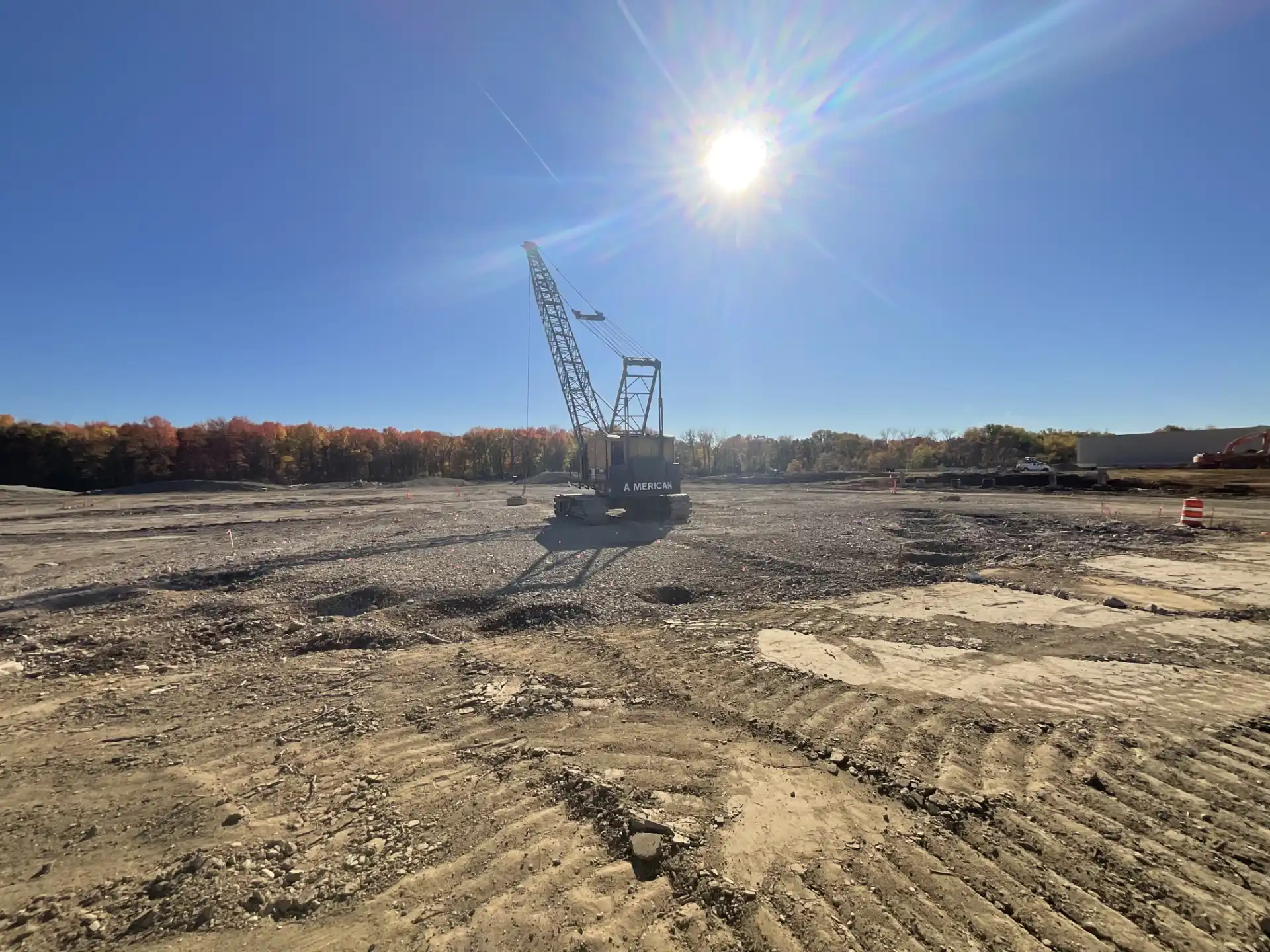
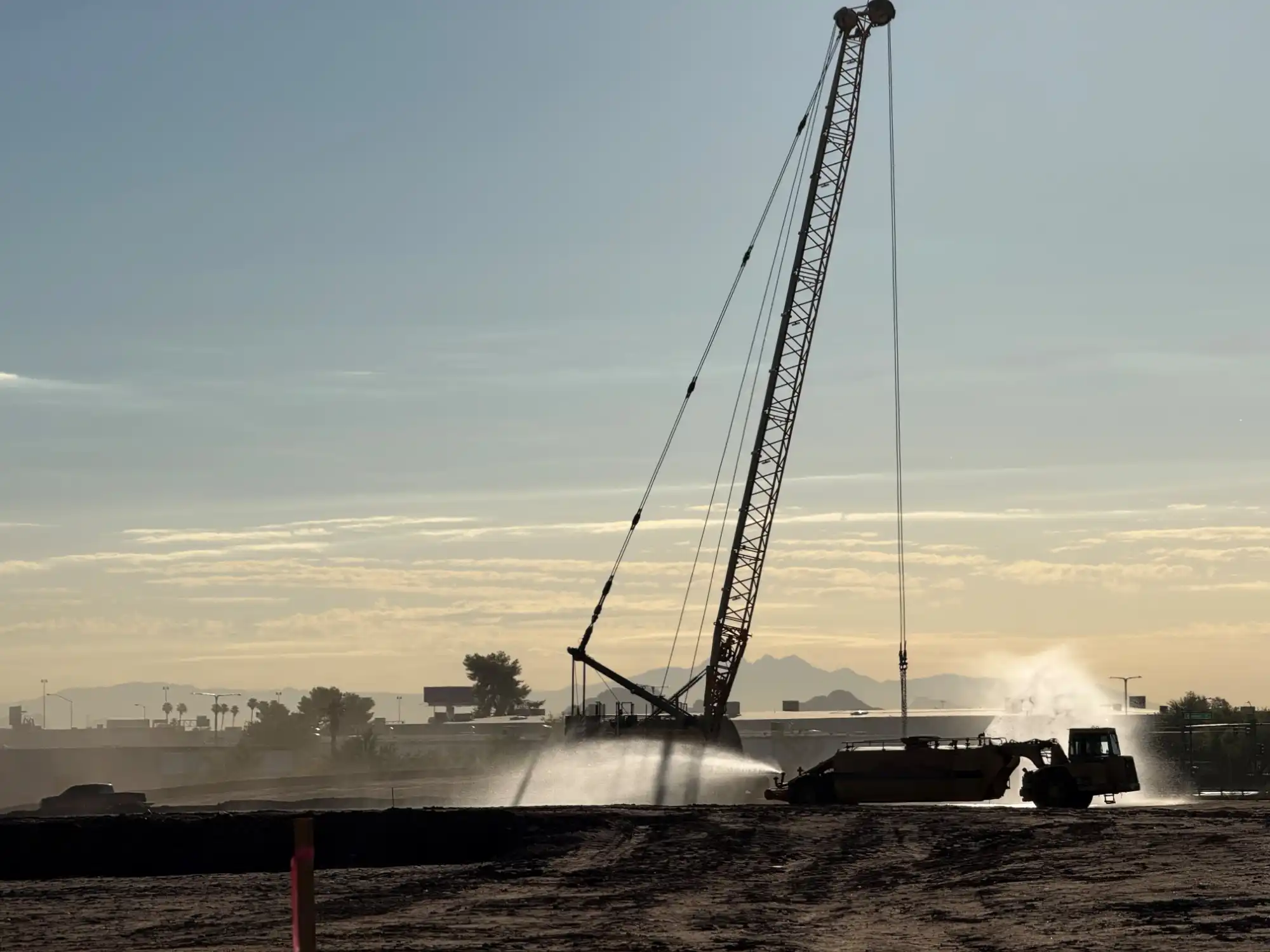
Dynamic compaction repeatedly drops weights from heights of 60 to 100 feet, creating shock waves that compact soil. Each impact generates a strong, measurable vibration. Monitoring during dynamic compaction verifies that drop heights and spacing achieve compaction objectives while limiting vibration at sensitive locations.
Experienced compaction engineers use monitoring data to guide the compaction sequence. Initial drops at conservative heights establish baseline ground response. Subsequent drops increase intensity as the team confirms that adjacent structures remain protected. This adaptive approach optimizes compaction results while maintaining safety margins throughout the work.
Soil Densification and Settlement
Ground improvement often includes soil densification (compaction) followed by settlement monitoring. Vibration monitoring during compaction measures ground response and helps verify that densification reaches design specifications. Post-compaction vibration monitoring can detect settlement patterns and provide early warning if settlement rates deviate from predictions.
Monitoring settlement response is valuable for future performance. Projects that achieve predicted settlement response during compaction tend to perform as predicted in service.
Ground Improvement of Challenging Soils
Difficult soils like those with high water tables, unstable particles, or collapsible structure require careful monitoring. Vibration monitoring reveals how these soils respond to compaction forces. Water-saturated soils often require different compaction strategies than dry soils. Monitoring data guides strategy adjustments in real-time.
The ground improvement techniques page at Densification provides detailed information on methods and applications. Professional ground improvement solutions start with thorough site characterization and monitoring to understand challenging soil conditions.
Vibration Monitoring Equipment and Sensors
Effective ground vibration monitoring depends on reliable, accurate equipment deployed and operated by experienced professionals.
Accelerometers and Velocity Sensors
Accelerometers measure ground acceleration directly. Tri-axial accelerometers measure vibration simultaneously in three perpendicular directions: vertical and two horizontal components. This three-dimensional measurement reveals whether vibration effects differ by direction, which is important because structures respond differently to vertical versus horizontal motion.
Velocity sensors (velocity transducers) measure ground velocity directly, eliminating the need for mathematical derivation. Some monitoring systems use velocity sensors for specific applications, particularly when measuring low-frequency vibrations where integration of acceleration data can introduce noise.
Modern sensors are robust, weatherproof, and accurate to within 5 to 10 percent. They survive typical construction site conditions, including temperature extremes, mud, dust, and vibration shock. Proper installation includes a secure coupling to the ground to ensure that sensor motion accurately reflects ground motion.
Data Acquisition and Wireless Transmission
Data acquisition systems convert analog sensor signals into digital data, sample at high rates (typically 2,000 to 10,000 samples per second), and transmit data to central processing and storage. Modern systems include onboard processing power, allowing local analysis and alert generation independent of network connectivity.
Wireless transmission via radio or cellular networks enables real-time remote monitoring. Project managers and consulting engineers can access live data from offices or other job sites. This capability supports communication with project teams, regulatory agencies, and property owners.
Battery-powered systems operate independently of site power infrastructure. Backup power ensures monitoring continues through power outages. Some systems include solar charging, reducing maintenance requirements on long-term projects.
Software Platforms for Analysis
Specialized software transforms raw vibration data into actionable information. Live dashboards display current vibration levels, frequency content, and alert status. Historical data views show trends and patterns. Automated report generation creates compliance documentation.
Professional software includes preset templates for common ground improvement scenarios, standard limits from applicable codes and regulations, and customizable alert thresholds. Analysis typically compares measured vibration against applicable standards, calculates statistics, and flags anomalies requiring investigation.
Selecting the Right Ground Vibration Monitoring Solution
Project-specific requirements guide monitoring system selection. There’s no one-size-fits-all approach.
Project-Specific Requirements
Start by defining monitoring objectives clearly. Are you verifying compaction effectiveness? Protecting adjacent structures? Meeting regulatory compliance? Establishing baseline conditions? Detecting settlement response? Each objective might suggest different monitoring strategies.
Site characterization informs system selection. How far are sensitive structures? What utilities exist underground? What are soil conditions? What’s the project timeline? Remote sites might require rugged, independent systems. Urban projects might benefit from real-time remote monitoring capability.
Equipment and System Selection
Once requirements are clear, evaluate monitoring system options. Do you need real-time analysis or will data-logging suffice? Should monitoring be fixed or portable? How many sensors and at what locations? What wireless or wired architecture makes sense?
Professional ground improvement contractors typically partner with specialized vibration monitoring firms rather than acquiring equipment themselves. Monitoring specialists provide expertise in system selection, proper deployment, data analysis, and regulatory compliance. This specialized approach ensures monitoring quality without requiring contractors to maintain expertise across multiple technical domains.
Professional Expertise and Support
The best monitoring system fails without experienced operation. Select monitoring partners based on their experience with your type of ground improvement work, demonstrated understanding of site-specific risks, commitment to regulatory compliance, and capability to provide real-time analysis and responsive support.
References from similar projects reveal how monitoring partners perform under pressure. Ask about their approach to equipment calibration, data validation, alert protocols, and communication with project teams.
Industry Standards and Best Practices
Professional ground vibration monitoring follows established industry standards and best practices.
Regulatory Compliance
ASTM D4150 defines a standard methodology for vibration measurement. USBM RI 8507 provides guidance on acceptable vibration levels from blasting and ground improvement operations. Most jurisdictions reference these standards or establish equivalent requirements.
State and local building codes often specify maximum allowable vibration for different structure types and uses. Historic preservation standards typically impose more stringent limits than modern structures. Environmental regulations might require monitoring and documentation of vibration and noise emissions.
Professional monitoring documentation includes equipment calibration records, sensor placement diagrams, measurement methodology, and compliance verification. This documentation supports regulatory agency inquiries and property owner communication.
Site Characterization and Baseline Data
Best practice begins with baseline vibration monitoring before work starts. Baseline data establishes natural ground vibration from sources like traffic, wind, and natural phenomena. Pre-work baseline monitoring also characterizes site soil response to vibration, providing a reference for interpreting vibration during active operations.
Post-work monitoring verifies that operations achieved design objectives and stayed within approved limits. Comparative analysis between baseline and post-work conditions documents project compliance and provides data for future reference.
Conclusion
Ground vibration monitoring is fundamental infrastructure for professional ground improvement projects. It transforms operational decisions from guesswork into engineering-based optimization. Real-time monitoring data guides compaction strategies, protects adjacent structures, ensures regulatory compliance, and provides documented evidence of project success.
The complexity of vibration physics and the importance of accurate measurement make professional expertise essential. Successful projects partner with vibration monitoring specialists who combine deep knowledge of ground improvement with sophisticated equipment and proven methodologies.
Ready to protect your project with professional ground vibration monitoring? Contact Densification to discuss your ground-improvement needs and to develop a monitoring strategy tailored to your specific project requirements.
Frequently Asked Questions
What is the difference between vibration monitoring and seismic monitoring?
Vibration monitoring measures short-duration, localized ground motion from construction operations, equipment, or industrial activity. Seismic monitoring measures natural earthquake activity and larger-scale ground motion. While both use similar sensor technology, their objectives and interpretation frameworks differ significantly.
How accurate is ground vibration monitoring equipment?
Modern accelerometers and data acquisition systems are accurate to within 5 to 10 percent. This accuracy is sufficient for engineering decision-making and regulatory compliance. Accuracy depends on proper sensor calibration, secure installation, and stable equipment operation maintained by experienced professionals.
Can ground vibration monitoring detect settlement?
Ground vibration monitoring during compaction reveals compaction effectiveness and soil response. Post-compaction vibration baseline measurements provide a reference for detecting settlement changes. However, specialized settlement monitoring (using tiltmeters, settlement plates, or other geotechnical instruments) is typically more effective for measuring actual vertical settlement.
What vibration levels are safe for nearby structures?
Safe vibration levels depend on structure type, construction, and foundation condition. Modern reinforced structures typically tolerate 1.0 to 2.0 inches per second peak particle velocity. Historic masonry buildings might safely tolerate 0.5 to 1.0 inches per second. Regulatory standards and site-specific structural assessments determine safe limits for specific projects.
How often should monitoring equipment be calibrated?
Professional monitoring systems should be calibrated at least annually and before major projects. Many monitoring providers recalibrate equipment more frequently to ensure reliability. Calibration certificates document equipment accuracy and compliance with standards.
Why should I hire professional vibration monitoring rather than doing it in-house?
Professional vibration monitoring specialists bring experience with ground improvement techniques, expertise in applicable standards and regulations, sophisticated equipment and software, and trained personnel for proper deployment and data analysis. This specialized expertise ensures monitoring quality, regulatory compliance, and actionable insights that would be difficult to achieve with in-house monitoring.