Deep Dynamic Compaction: Methods, Equipment, and Project Applications
Some ground improvement methods are elegant. Deep dynamic compaction is not one of them. It is direct, high-energy, and remarkably effective: you lift a very heavy weight to a significant height and drop it onto the ground, repeatedly, until the soil below densifies enough to support whatever you plan to build on it.
What makes deep dynamic compaction worth understanding in detail is not just its simplicity. It is the combination of speed, cost efficiency, and treatment depth that few other ground improvement methods can match on the right site. For engineers working with loose fills, granular soils, or land reclamation areas, it is often the first method worth evaluating.
This post covers how the process works, what equipment is involved, which soil types respond well, and how dynamic compaction ground improvement fits into a broader turnkey project delivery model.
What Is Deep Dynamic Compaction?
Deep dynamic compaction (DDC) is a ground improvement technique that uses the repeated impact of a heavy weight, dropped from height, to densify loose or weak soils to significant depth. The process works by transmitting high-energy shockwaves through the ground, forcing soil particles to rearrange into a denser, more stable configuration.
It is one of the oldest and most widely used ground improvement methods in geotechnical engineering. First formalized in modern practice by Louis Ménard in the 1970s, DDC has since been applied on projects across every continent, from infrastructure developments and industrial facilities to land reclamation and mine backfill stabilization.
How the Process Works
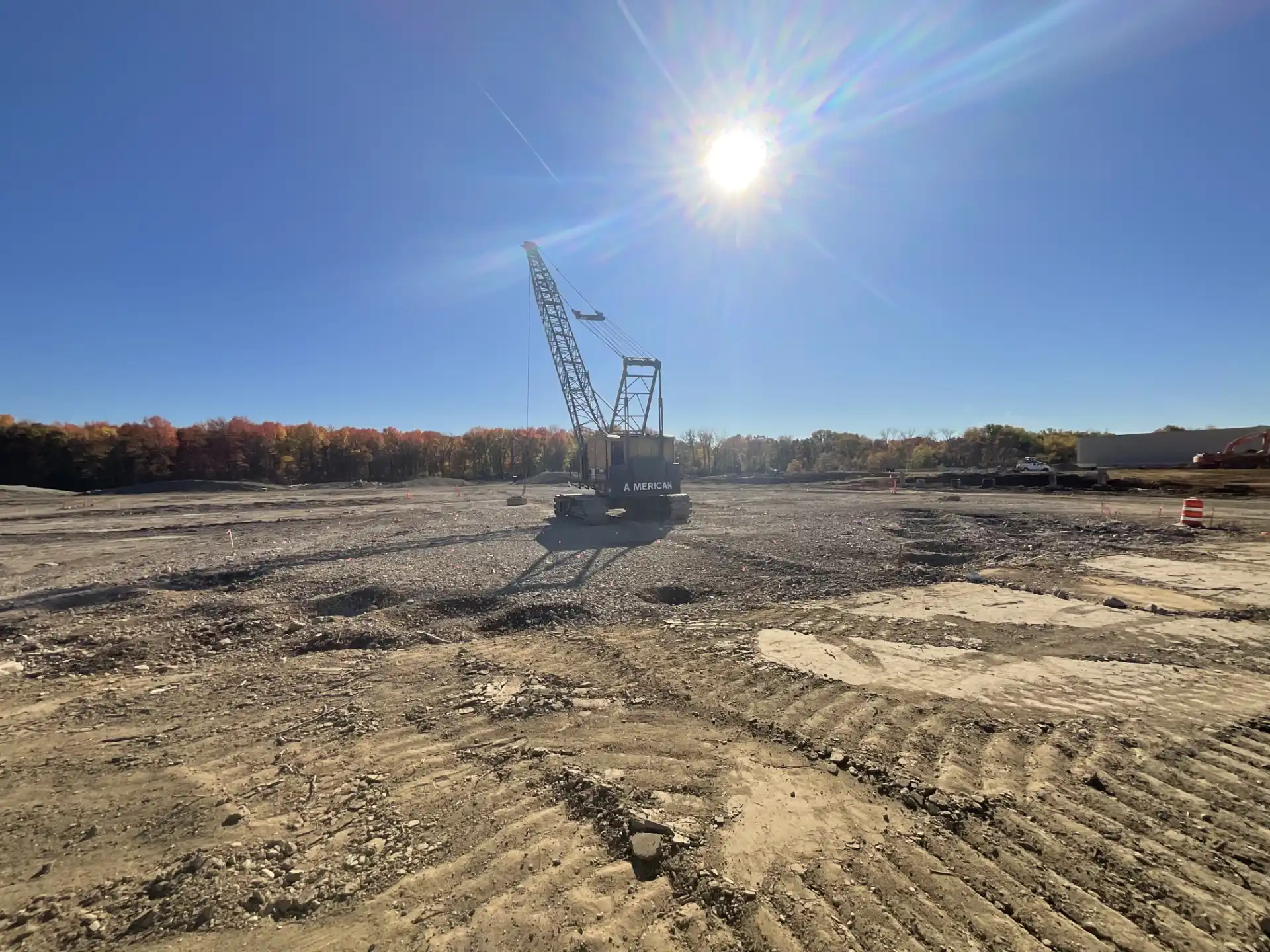
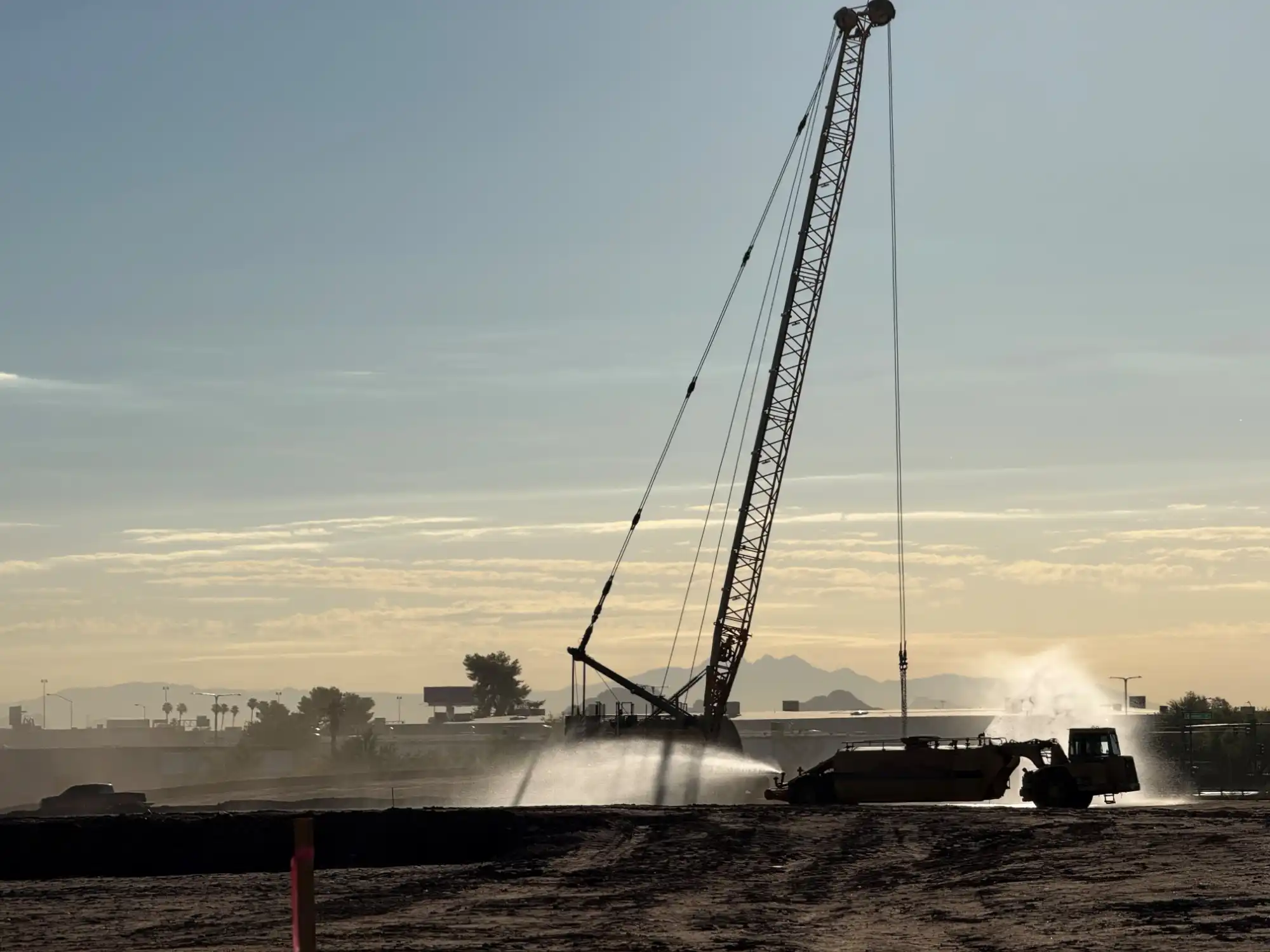
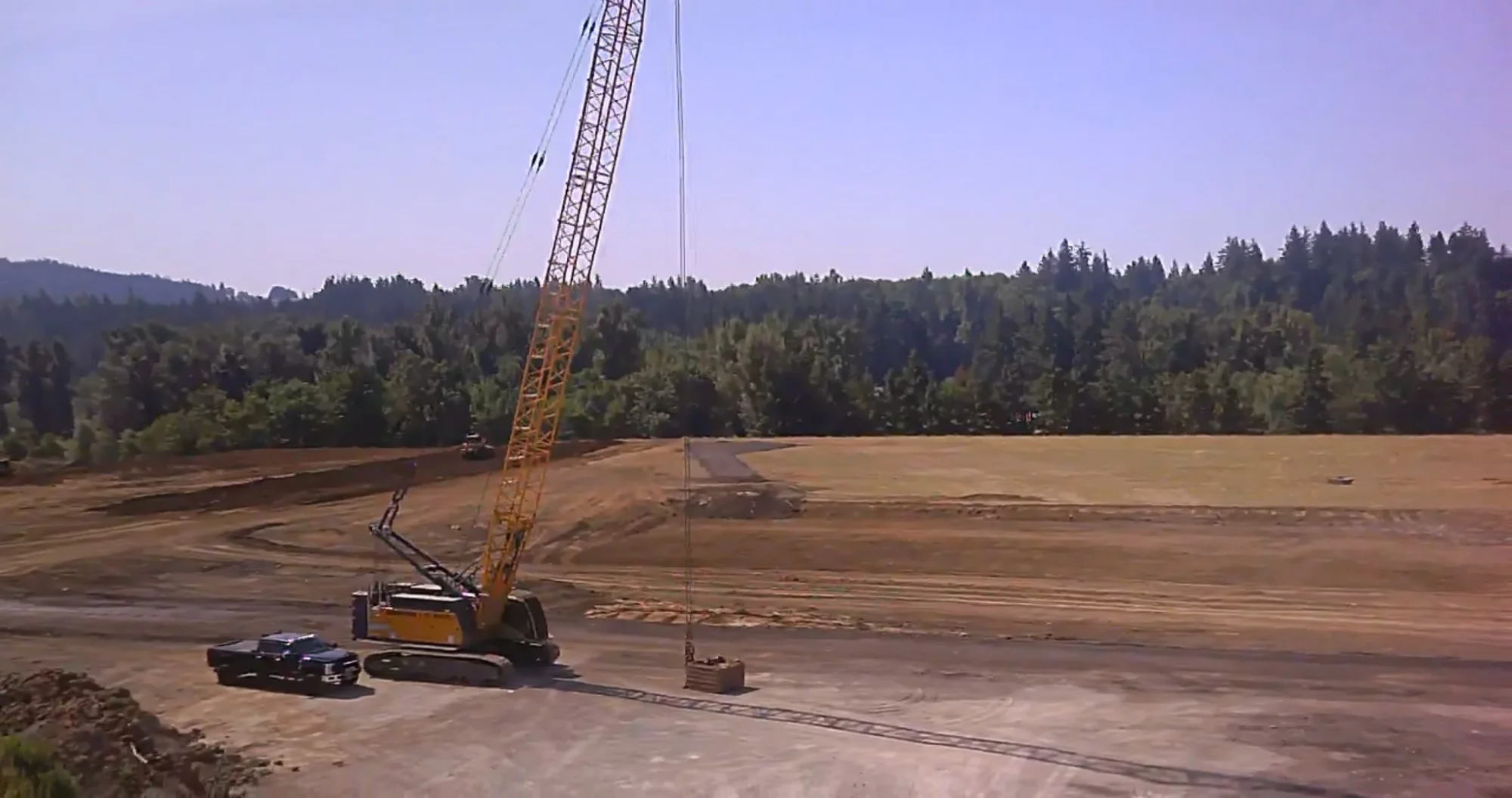
The fundamental mechanic is straightforward. A crane lifts a steel or concrete pounder, typically weighing between 5 and 40 tonnes, to a drop height ranging from 10 to 40 meters. The pounder is released and falls under gravity, striking the ground surface at a designated impact point. The process is repeated across a grid of impact points that covers the treatment area, with multiple passes applied in sequence.
Each impact sends a wave of compressive and shear energy into the ground below. As that energy propagates downward and outward, it forces loose particles closer together, reducing void ratios and increasing the density and bearing capacity of the treated soil mass.
The Physics Behind Soil Densification
The depth of treatment is primarily a function of the applied energy per impact, expressed as the product of the pounder mass and the drop height. Higher energy inputs produce deeper treatment. The Federal Highway Administration’s ground improvement technical guidance provides useful reference frameworks for estimating treatment depth based on energy parameters, though site-specific testing always governs final design.
Importantly, deep dynamic compaction works because of what happens between impacts, not just during them. After each pass, the ground needs time to consolidate and for pore pressures to dissipate, particularly in finer-grained soils where drainage is slower. Managing the timing between passes is a key part of competent DDC execution.
Deep Dynamic Compaction Equipment
The equipment program for a DDC project is purposefully heavy-duty. Getting the process right requires machinery with sufficient lifting capacity, reach, and reliability to sustain high-energy drops across a large treatment area without mechanical failure.
The Crane and Pounder Setup
The primary piece of deep dynamic compaction equipment is a heavy-lift crane with a free-fall or controlled-drop capability. The crane must be rated to handle not just the static weight of the pounder but the dynamic loads associated with repeated free-fall drops. Standard lattice boom cranes modified for DDC work are common. Dedicated DDC cranes with reinforced boom configurations are used on higher-energy programs.
The pounder itself is typically a square or octagonal steel or concrete block. Its geometry is designed to concentrate impact energy at the point of contact with the ground rather than distributing it laterally. Pounders used by experienced dynamic compaction contractors range from 5 tonnes for shallow treatment programs up to 40 tonnes or more for deep fills requiring maximum energy input.
Ancillary equipment typically includes:
- Track-mounted cranes or crawler units capable of moving across soft or recently treated ground
- Survey equipment for precise grid layout and drop point positioning
- Vibration monitoring sensors positioned relative to sensitive structures adjacent to the site
Weight, Drop Height, and Energy Calculations
The applied energy per impact, often called the specific energy or impact energy, is calculated as the mass of the pounder multiplied by the acceleration due to gravity and the drop height. Total energy applied to a given area, expressed in tonne-meters per square meter, is a key design parameter.
For a simplified approximation of treatment depth, practitioners often use the relationship developed through field observation: effective treatment depth is roughly equal to the square root of the product of the pounder mass in tonnes and the drop height in meters, multiplied by an empirical coefficient that reflects soil type and drainage conditions. This relationship, reviewed in publications like the DFI Journal, provides a starting point for design, with confirmation through post-treatment testing.
Applicable Soil Types for Deep Dynamic Compaction
Deep dynamic compaction is not a universal solution. It works exceptionally well on certain soil profiles and poorly on others. Understanding where it performs best is essential to specifying it correctly.
Best Candidates: Granular and Loose Fill Soils
DDC performs best in soils that are free-draining, coarse-grained, and capable of rapid particle rearrangement under impact. The strongest candidates include:
- Loose sand and gravelly sand
- Hydraulic fill and land reclamation material
- Uncontrolled or engineered fill with high void ratios
- Collapsible soils in arid environments
- Granular mine tailings and industrial fill
These materials respond well because the applied energy can compact soil particles without generating excess pore pressures that would prevent densification. Treatment can often begin and achieve measurable results quickly, making DDC a cost-efficient choice on sites with large treatment areas and relatively homogeneous soil profiles.
You can review a detailed breakdown of soil suitability in our applicable soil types for dynamic compaction reference, which outlines the conditions where DDC delivers predictable results.
When DDC Is Not the Right Choice
Deep dynamic compaction is generally not suitable for soft, saturated fine-grained soils such as soft clays or plastic silts. In these materials, the impact energy generates high pore water pressures that do not dissipate quickly enough to allow effective densification. The result is ground disturbance rather than improvement.
Sites with high water tables directly at the surface, very soft organic layers, or shallow utilities can also present constraints that make DDC impractical without significant site preparation. When DDC is not the right fit, our team evaluates other ground improvement methods as part of a broader program assessment.
The Deep Dynamic Compaction Process: Step by Step
Executing a DDC program successfully requires systematic planning, disciplined field execution, and verification testing at each stage.
Site Assessment and Grid Layout
Before the first drop, a thorough site assessment establishes the soil profile, groundwater conditions, existing utilities, and the proximity of sensitive structures. This informs the energy program, the grid spacing, and the vibration management plan.
Grid layout defines the impact point locations across the treatment area. Grids are typically square or triangular, with spacing determined by the required treatment depth and the pounder dimensions. Tighter grids deliver more thorough energy coverage but require more passes and more time on site.
Impact Phases and Ironing Passes
A standard DDC program involves two or more high-energy passes across the primary grid, followed by a final low-energy ironing pass. The primary passes deliver the majority of the densification energy and treat the soil to the target depth. The ironing pass treats the upper meter or two of ground that is disturbed by crater formation during primary impacts, producing a more uniform and workable surface.
Between passes, the site is typically leveled with granular fill to restore the working surface, and time is allowed for excess pore pressures to dissipate before the next pass begins. Managing the timing between passes is as important as the energy program itself.
Post-Treatment Testing and Verification
Verification testing confirms that the treatment achieved the specified improvement objectives. Standard test methods include:
- Dynamic cone penetration tests (DCPT)
- Standard penetration tests (SPT)
- Cone penetration tests (CPT)
- Plate load tests for surface bearing capacity confirmation
Testing is performed at locations distributed across the treatment grid, typically at the midpoints between impact craters where the least energy was delivered, to confirm that minimum densification criteria are met everywhere, not just at the impact points. Our approach to post-improvement testing and analysis is designed to give clients defensible verification data, not just a pass/fail result.
Project Applications: Where DDC Delivers Results
The scale and cost efficiency of deep dynamic compaction make it well suited to a specific set of project types. When the site conditions align, DDC is hard to beat on both performance and economics.
Industrial and Infrastructure Sites
Large industrial facilities built on granular fill or loose native soils are among the most common applications for DDC. Warehouses, tank farms, port facilities, and heavy manufacturing plants all require uniform bearing capacity across large plan areas, and DDC can treat those areas efficiently. Infrastructure projects including highway embankments, airport aprons, and rail yard subgrades have also used DDC successfully where suitable soils are present.
Land Reclamation and Fill Improvement
Reclaimed land created by hydraulic filling or end-dumping often contains loosely deposited granular material that is unsuitable for construction in its initial state. Deep dynamic compaction is a primary tool for improving reclaimed fills because it can treat large volumes of material quickly and cost-effectively once the fill has been placed and initial settlement has occurred.
International Project Experience
Dynamic compaction contractors with international experience bring an understanding of how soil conditions, equipment availability, and project logistics vary significantly across different geographies. Densification, Inc. has applied dynamic compaction technique and ground improvement methods across North America, the Caribbean, and international project sites, developing field experience across a range of soil types, climates, and project delivery environments. You can explore project highlights on the Densification, Inc. website.
How Deep Dynamic Compaction Fits Into a Turnkey Ground Improvement Program
On complex projects, deep dynamic compaction rarely operates in isolation. It is most effective when delivered as part of a coordinated program that includes pre-treatment assessment, field monitoring, and post-treatment verification testing under a single responsible contractor.
From Assessment to Completion
A turnkey approach means the same team that designs the energy program also executes the field work, manages vibration monitoring, and performs the verification testing. There is no handoff between a design consultant, a monitoring subcontractor, and a ground improvement contractor who have never worked together before. The program is integrated from the start.
This matters because decisions made in the field, such as adjusting drop heights, modifying grid spacing in response to variable soil conditions, or managing the timing between passes based on pore pressure dissipation rates, require that the executing team has a deep understanding of the design intent. Separation between design and execution creates gaps that can affect both quality and schedule.
Why Specialized Contractors Matter
Not all dynamic compaction contractors carry the same depth of experience. DDC is a method that looks straightforward from a distance but rewards experience in execution. Equipment selection, energy program calibration, monitoring protocol, and testing interpretation all benefit from a contractor who has delivered DDC on a wide range of soil conditions and project types.
To discuss how deep dynamic compaction could work on your next ground improvement project, contact the Densification team and let us walk through your site conditions together.
Frequently Asked Questions
What is deep dynamic compaction used for?
Deep dynamic compaction is used to densify loose, granular, or fill soils to significant depth, improving their bearing capacity and reducing settlement potential. It is commonly applied on industrial sites, infrastructure projects, and land reclamation areas where large treatment volumes need to be improved efficiently before construction begins.
How deep can dynamic compaction treat soil?
Treatment depth depends on the energy per impact, which is a function of pounder mass and drop height. In practice, effective treatment depths typically range from 3 to 12 meters for standard programs, with higher-energy programs potentially reaching deeper. Site-specific soil conditions and post-treatment testing results govern the confirmed depth of improvement.
What soils are best suited for deep dynamic compaction?
Deep dynamic compaction works best in free-draining, coarse-grained soils including loose sand, gravel, hydraulic fill, and uncontrolled fill with high void ratios. It is generally not suitable for soft, saturated fine-grained soils such as soft clays and plastic silts, where pore pressure buildup prevents effective densification.
How is deep dynamic compaction different from regular soil compaction?
Standard soil compaction, such as roller compaction, works on the surface layer and treats only the top 300-600 mm of material. Deep dynamic compaction uses high-energy impacts to treat soil to depths of several meters. It is a ground improvement method used to address weak conditions well below the surface, not just the working layer.
How long does a deep dynamic compaction program take?
Project duration depends on the treatment area, the required energy program, and the number of passes specified. A well-resourced DDC program can treat large areas relatively quickly compared to other ground improvement methods, which is one of its practical advantages on industrial and infrastructure sites with tight construction schedules.
What testing is done after deep dynamic compaction?
Post-treatment verification testing typically includes cone penetration tests, standard penetration tests, or dynamic cone penetration tests performed at locations across the treatment grid. Testing confirms that the soil has been densified to the specified criteria throughout the treatment area, not just at the impact points directly beneath each drop location.