Dynamic Ground Compaction for Large-Scale Industrial Site Development
Large industrial developments carry large consequences when the ground performs below expectations. A warehouse floor that settles unevenly, a logistics yard that develops soft spots under repeated heavy loading, or a manufacturing facility that requires remediation years after construction: these are not hypothetical risks. They are outcomes that happen when ground improvement is treated as an afterthought or assigned to a contractor without specialized capability.
Dynamic ground compaction is one of the most effective and cost-efficient methods available for improving weak or loose soils on an industrial scale. When properly designed and executed, it delivers great, verified improvement across large site areas with a speed and economy that alternative methods often cannot match.
This post explains how dynamic compaction works, why it is particularly well-suited to large industrial projects, and what a well-executed program looks like from initial assessment through certified completion.
What Is Dynamic Ground Compaction and How Does It Work?
Dynamic ground compaction, also called dynamic compaction, is a ground improvement technique that improves loose or compressible soils by repeatedly dropping a heavy weight from a significant height onto the ground surface. The energy of impact travels downward through the soil, rearranging particles, closing voids, and increasing density throughout the target depth.
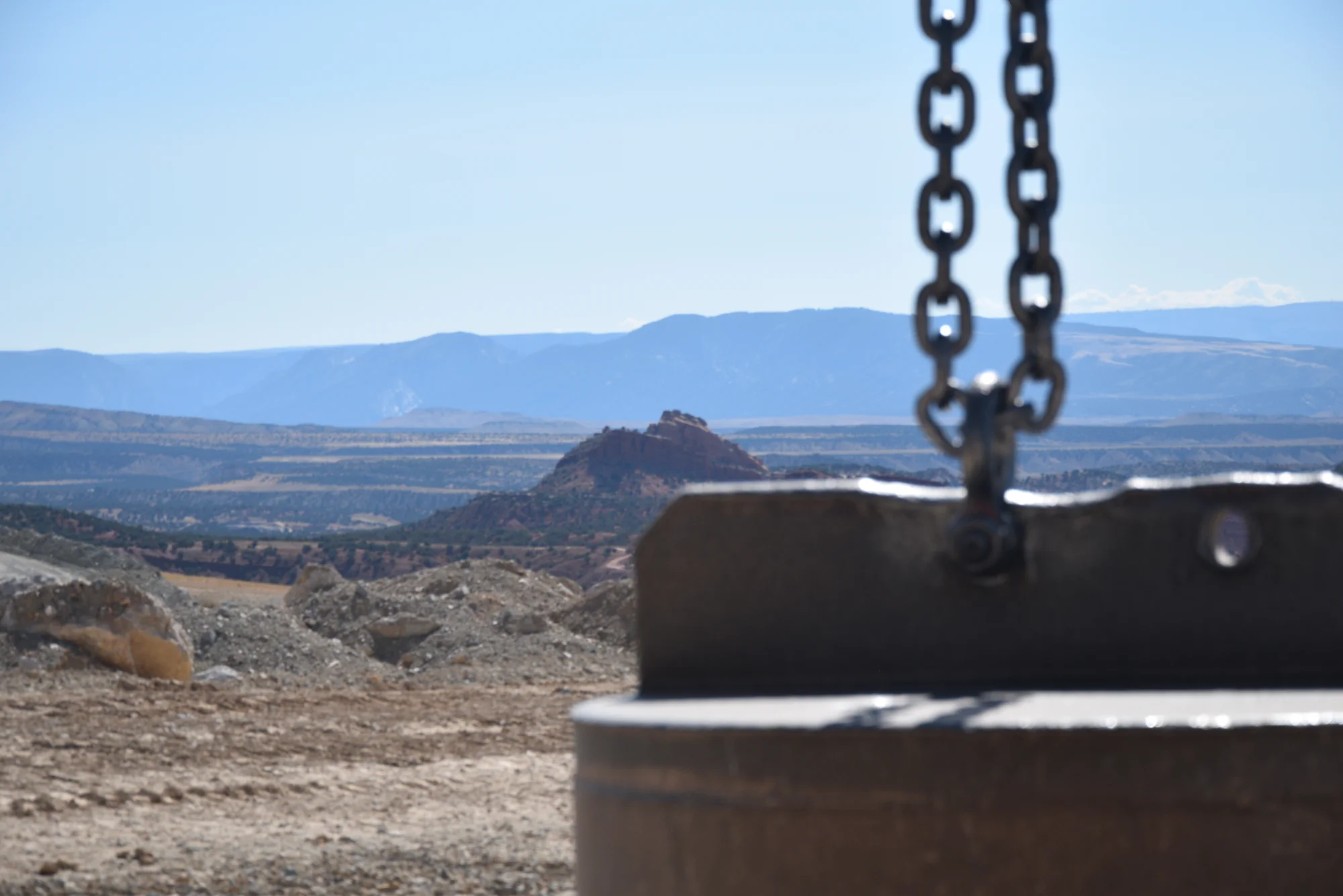
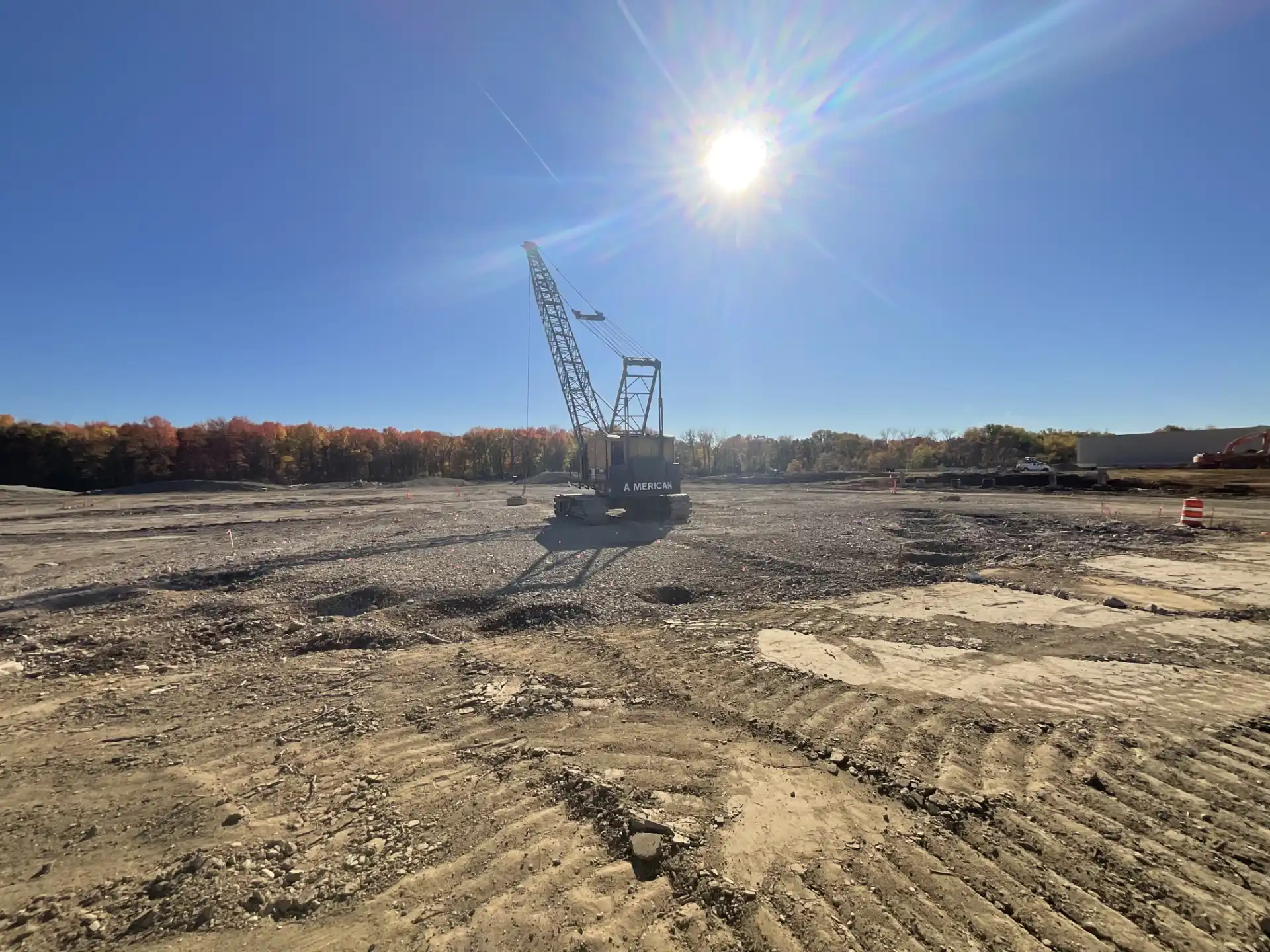
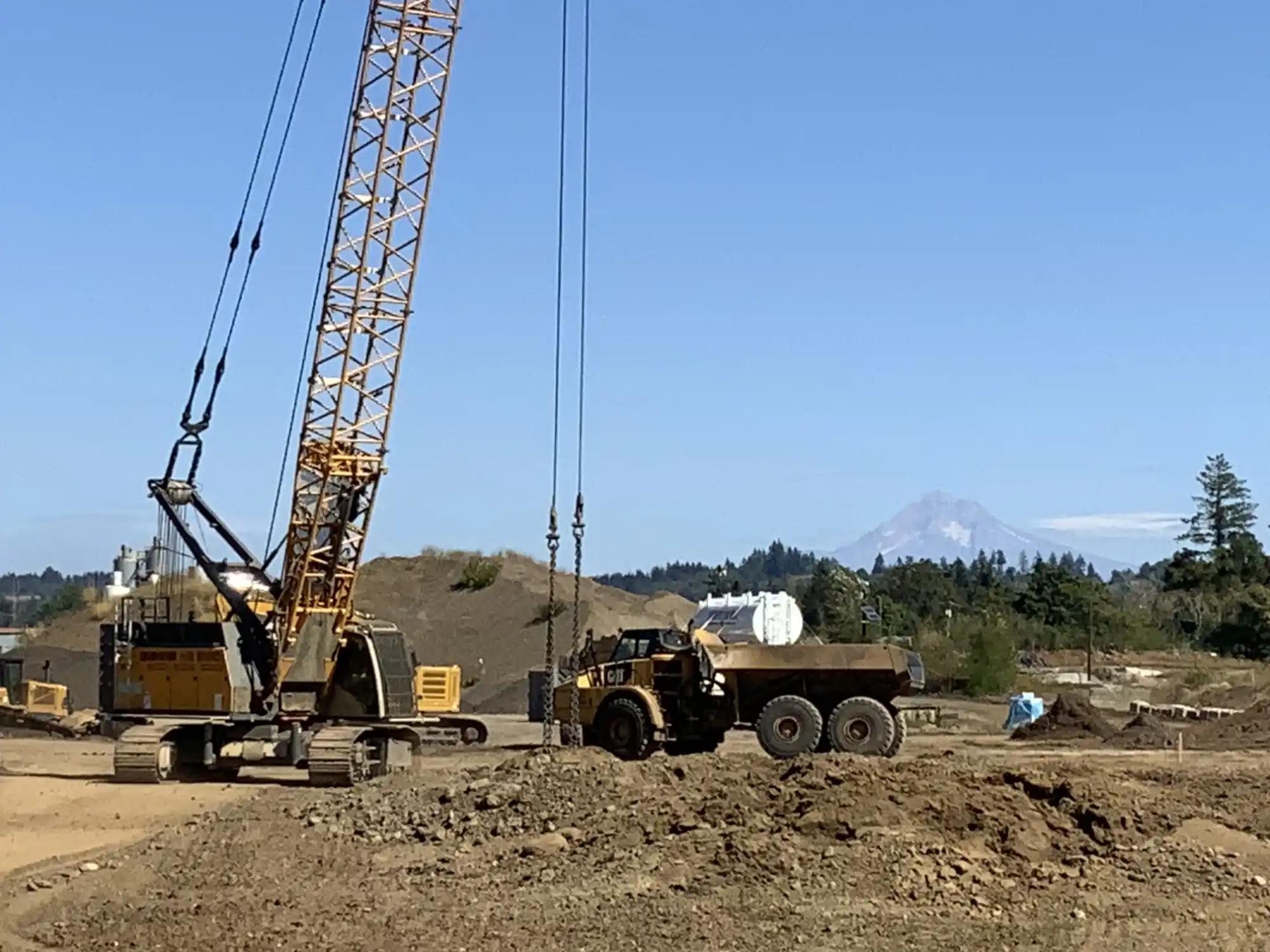
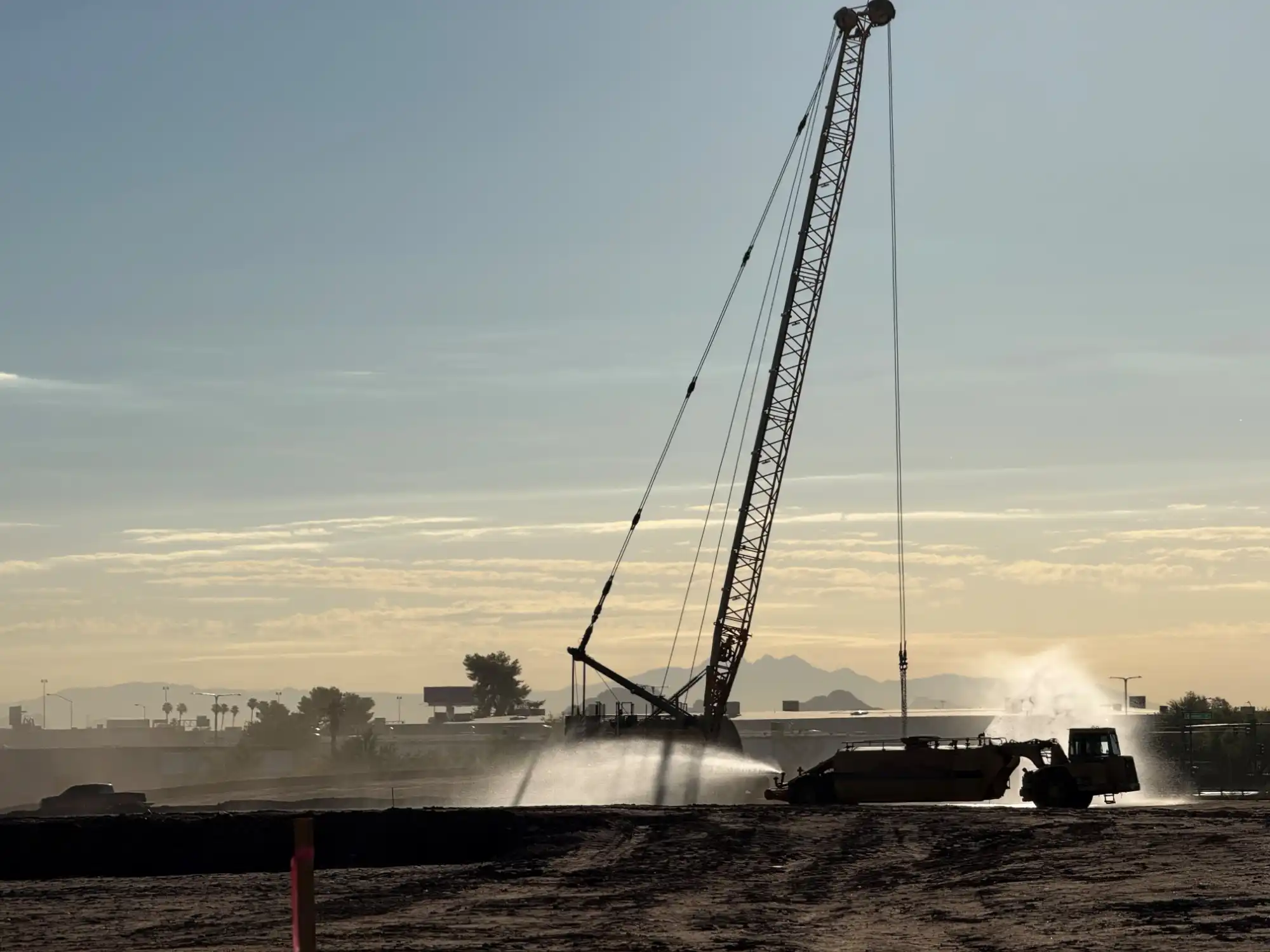
The process is straightforward in principle and highly effective in practice when matched to the right soil conditions. A crane positions the drop weight, typically ranging from 5 to 40 metric tons, at a predetermined height. The weight is released, strikes the surface, and the impact energy propagates through the soil profile. This cycle is repeated across a systematic grid pattern until the target energy has been delivered to each location.
The Basic Mechanics of Impact-Based Densification
The FHWA Ground Improvement Reference Manual describes dynamic compaction as one of the most powerful methods for improving granular soils at depth. The depth of improvement is primarily a function of the applied energy per blow, expressed as the product of drop weight and drop height. Higher energy produces greater improvement, which is why heavy cranes and large drop weights are standard equipment on industrial-scale projects.
Between primary passes on the grid, the soil needs time to respond. In granular soils, excess pore pressures generated by impact loading dissipate relatively quickly, allowing particles to consolidate into a denser arrangement. A secondary pass then addresses the upper zone, and a final ironing pass brings the surface to a uniform, stable condition.
How Deep Dynamic Compaction Handles Large Site Areas
On large industrial developments, the scale of the site demands a systematic, organized approach to grid layout, crane positioning, and progress tracking. Deep dynamic compaction programs on industrial sites often cover tens of thousands of square meters, requiring careful logistics planning to keep the work moving efficiently.
We use structured grid mapping and production tracking on every large-scale project to confirm that each point on the treatment area receives the specified energy. This documentation feeds directly into the post-treatment verification record, which is a requirement on virtually every industrial ground improvement contract.
Why Large Industrial Developments Benefit from Ground Compaction
Industrial sites present specific geotechnical challenges that make dynamic compaction a particularly good fit. The combination of large footprints, heavy anticipated loads, and often variable fill or native soil conditions aligns well with what this method delivers.
Handling Variable Fill and Loose Deposits at Scale
Industrial development sites, especially those repurposing former industrial land, frequently contain heterogeneous fill placed over decades without engineering control. Random debris, organic materials, and variable soil types can all be present within the same profile. Dynamic compaction is one of the few ground improvement techniques capable of improving this kind of variable ground across a large area in a relatively short time.
Where alternative methods require point-by-point treatment, such as driven piles or drilled inclusions, dynamic compaction covers the entire surface with uniform energy application. This makes it particularly efficient on sites where the problematic zone covers the full development footprint rather than just specific column locations.
Cost and Time Advantages Over Alternative Ground Improvement Methods
The Deep Foundations Institute has published comparative analyses showing that dynamic compaction often delivers a lower cost per cubic meter of improved soil than rigid inclusion methods on appropriate soil types. The primary driver of this advantage is production rate: a properly equipped dynamic compaction crew can treat large areas quickly, whereas methods requiring individual installation points, such as stone columns or rigid inclusions, require proportionally more time and equipment as the site area increases.
For industrial projects with tight schedules and large footprints, this production advantage is significant. Soil compaction for construction on industrial sites is a time-sensitive phase because ground improvement must be verified before foundation design can be finalized and structural work can begin.
What Ground Conditions Are Best Suited for Dynamic Compaction?
Dynamic compaction is not the right answer for every site, but for the right conditions, it is an exceptionally powerful tool. Understanding where it works best helps engineers and developers make confident method selection decisions.
Soil Types That Respond Well to Dynamic Compaction
The method performs best in:
- Loose granular soils: clean sands, gravels, and sandy fills respond rapidly to impact energy and achieve high densities efficiently
- Coarse fill and demolition debris: dynamic compaction can break down and densify fills that contain coarse fragments or mixed material
- Collapsible soils: arid-region soils prone to collapse under wetting can be pre-treated with dynamic compaction to eliminate this risk before construction
- Partially saturated silts and sandy silts: with appropriate program design and pass sequencing, improvement is achievable in less permeable soils
For guidance on which soil types are suitable and which require alternative approaches, our applicable soil types page provides a detailed engineering reference.
Site Conditions That Require Engineering Evaluation First
Dynamic compaction is not suitable for:
- Soft clays or high-plasticity soils that do not respond predictably to impact energy
- Sites adjacent to sensitive structures where vibration limits cannot be met within the required grid spacing
- Soils with artesian groundwater conditions that cannot be managed within the treatment program
On sites that present any of these conditions, engineering evaluation determines whether a modified approach, such as combining dynamic compaction with drainage measures or substituting an alternative ground improvement technique, is appropriate.
How Is a Large-Scale Dynamic Compaction Program Executed?
A well-executed dynamic compaction program on a large industrial site is not simply a matter of sending equipment and dropping weights. It requires systematic planning, real-time monitoring, and disciplined documentation from start to finish.
Site Preparation, Grid Layout, and Equipment Requirements
Before any compaction passes begin, the site is prepared, and the treatment grid is laid out based on the design specification. Grid spacing, point locations, and energy targets are determined from the geotechnical investigation data and the engineering design. The crane and drop weight combination selected for the project reflects the target improvement depth and the soil conditions documented in the investigation.
Crane selection is a critical decision on large industrial projects. The equipment must be capable of reliably delivering the specified drop height and drop weight across the full grid without constraints from the site geometry or access conditions. Our equipment fleet is configured for exactly these kinds of large-scale deployments.
Monitoring, Energy Levels, and Pass Sequencing
During active compaction work, we document the number of blows delivered at each compaction point and record the depth of the resulting crater once the required number of blows has been completed. As a point approaches refusal, defined by a maximum penetration criterion per blow and the specified energy has been delivered, the crew moves to the next location. This data is recorded for every point on the grid and feeds into the post-treatment documentation.
Ground vibration monitoring runs concurrently with compaction operations on sites near structures, utilities, or property boundaries. This protects adjacent assets and confirms that ground vibration remains within specified limits throughout the program. Our ground improvement capabilities include integrated vibration monitoring as a standard component of every project where adjacent structures are present.
What Does Post-Compaction Testing Look Like on Industrial Projects?
The compaction program is not complete when the last pass is finished. Verification testing is the step that confirms the work has achieved its engineering purpose, and on industrial projects, this testing must meet contractual acceptance criteria before the site is handed back.
Verification Testing Methods and Acceptance Criteria
Standard verification methods on industrial ground compaction projects include:
- CPT (Cone Penetration Test) soundings for continuous resistance profiles at representative locations across the treated area
- SPT (Standard Penetration Test) borings, where laboratory samples are also required for classification or comparison
- Plate load testing at specific locations where local bearing capacity confirmation is required
- Settlement monitoring to track ongoing response in the days and weeks following treatment
Acceptance criteria are established in the design phase, typically expressed as minimum tip resistance (CPT) or blow count (SPT) at specified depths. ASTM D5778 governs the CPT procedure, and ASTM D1586 governs the SPT procedure. Results are plotted against pre-treatment baselines to confirm that the required improvement was achieved.
On industrial projects, the verification record also becomes part of the project documentation package, supporting the structural engineer’s foundation design and providing a baseline for any future investigations on the site.
How We Deliver Dynamic Compaction on Complex Industrial Sites
We approach large industrial ground compaction projects as integrated engineering and construction programs, not simply as equipment deployment exercises. That distinction matters on complex sites where conditions change, schedules are tight, and the client’s downstream work depends on our certified results.
Turnkey Execution from Assessment Through Completion
Our turnkey ground improvement services cover the full scope of work from geotechnical review and program design through compaction execution, post-treatment testing, and final reporting. Clients working with a single accountable contractor for this entire scope avoid the coordination gaps that can develop when investigation, design, and construction are split across multiple firms.
We’ve mobilized on large industrial sites where the footprint alone required strategic grid planning and multi-phase compaction passes. Our equipment fleet and project management approach are built for exactly this kind of scale.
Equipment Fleet and Operational Capacity
Large-scale dynamic compaction solutions demand equipment configured for sustained heavy production. Our fleet includes crane and drop weight combinations capable of delivering high-energy programs on large areas with the logistical support required to keep production moving. We coordinate equipment positioning, grid sequencing, and monitoring operations as a single integrated program, which is how complex industrial projects get completed on schedule with a complete verification record.
To discuss your site conditions and how dynamic ground compaction can support your industrial development, reach out to us at chris@densification.com. We’re ready to walk through your project requirements and put together a program designed around what your site actually needs.
Frequently Asked Questions
What is dynamic ground compaction used for? Dynamic ground compaction is used to densify loose or compressible soils across large areas, most commonly on industrial, commercial, and infrastructure development sites. It improves load-bearing capacity, reduces settlement potential, and creates a stable ground profile suitable for heavy structures and pavements.
How deep can dynamic compaction improve the soil? Improvement depth depends on the energy applied per blow, which is the product of drop weight and drop height. Standard programs achieve reliable improvement to depths of 3 to 10 meters. High-energy programs with large drop weights can produce meaningful improvement to 12 meters or more, depending on soil conditions.
What soil types are not suitable for dynamic compaction? Soft clays, high-plasticity soils, and soils with artesian groundwater conditions are generally not suitable for standard dynamic compaction programs. Sites adjacent to sensitive structures that cannot tolerate ground vibration may also require alternative ground improvement techniques or modified approach designs.
How long does a large-scale ground compaction program take on an industrial site? Program duration depends on site area, required improvement depth, soil conditions, and the number of compaction phases specified. A well-equipped contractor can cover large areas efficiently, but the waiting periods between phases for pore pressure dissipation must be factored into the schedule. Verification testing adds time at the end of the program before the site can be certified.
What is the difference between dynamic compaction and deep dynamic compaction? Both terms refer to the same impact-based densification method. Deep dynamic compaction specifically emphasizes the application of high-energy drops designed to achieve improvement at significant depth, typically greater than 5 meters. The method and equipment are the same; the distinction is in the energy level and the depth of the target improvement zone.